A child's first pair, and what actually decides it
Parents choose a first pair by the front and then spend a term hunting for the back. What the paediatricians say about timing and the first six weeks is worth reading before either decision, and it is the part a shop has no business advising on.

The back matters more than the front
The first decision is often made by looking at the front. A small heart, star, bow or clear cubic zirconia catches the eye, and the colour may settle the choice. For a child, the back can decide how the pair fits into ordinary days.
A butterfly clutch is the sprung back found on many earrings. It has two wings and a rim, and it can be pulled off. That movement may happen as a jumper comes off, during a swim, or when a hairbrush catches nearby hair. The child may only notice the missing earring at bedtime.
A screw back works differently. The post has a thread cut into it, and the front turns onto that thread. It does not come off until it is turned back. This is a mechanical difference, not a promise about what your child will prefer or how they will behave.
Our children's shelf includes screw back and flat back pairs. A flat back has a plain disc that lies against the skin. It gives you another shape to consider, especially when the visible front is only part of the choice.
The child still needs to be part of the decision. A front they recognise may make the pair easier to accept, while the back determines how you handle the earrings day after day. Think about both parts before you focus on the picture on the front.
No jewellery choice replaces advice about a new piercing. The back becomes a practical question after you have followed the guidance for the piercing itself and know what stage you are choosing for.
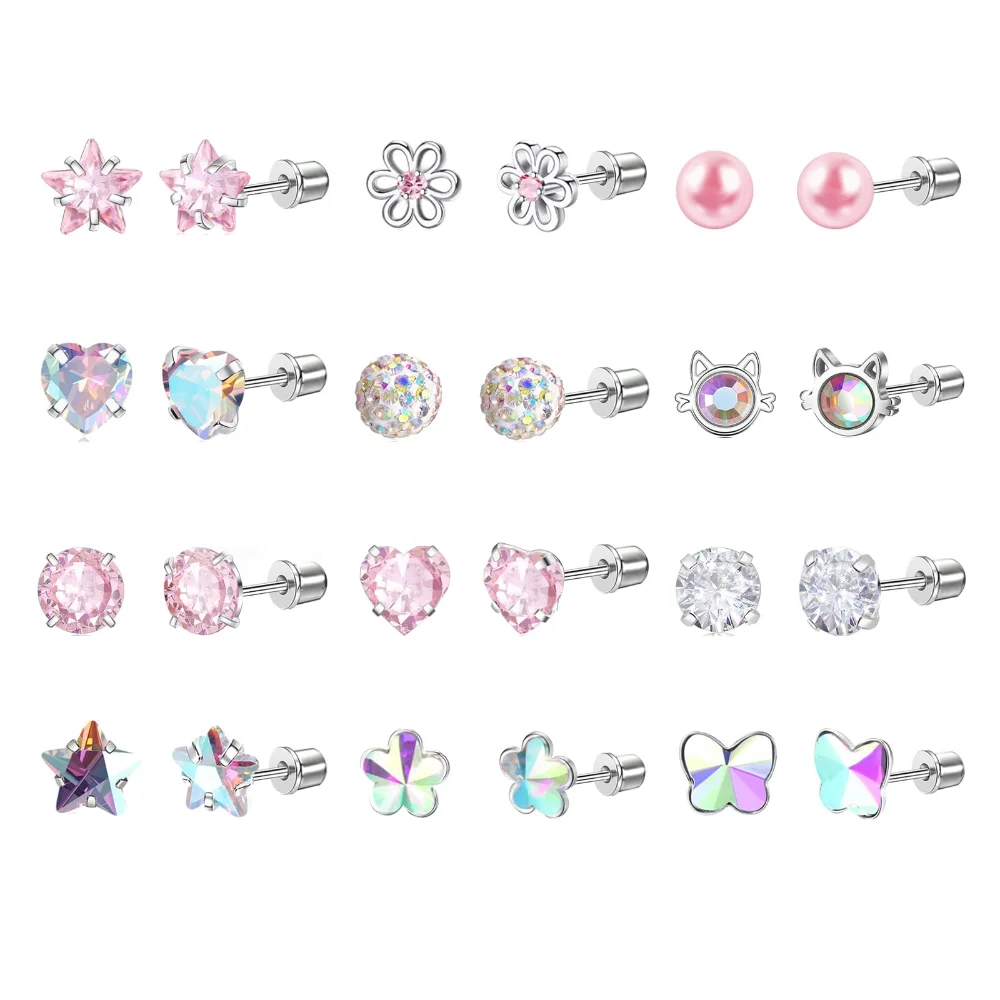
DAILI Screw back earrings for children with cubic zirconia
12 pairs · Surgical steel, 20G · Flat back
$12.99
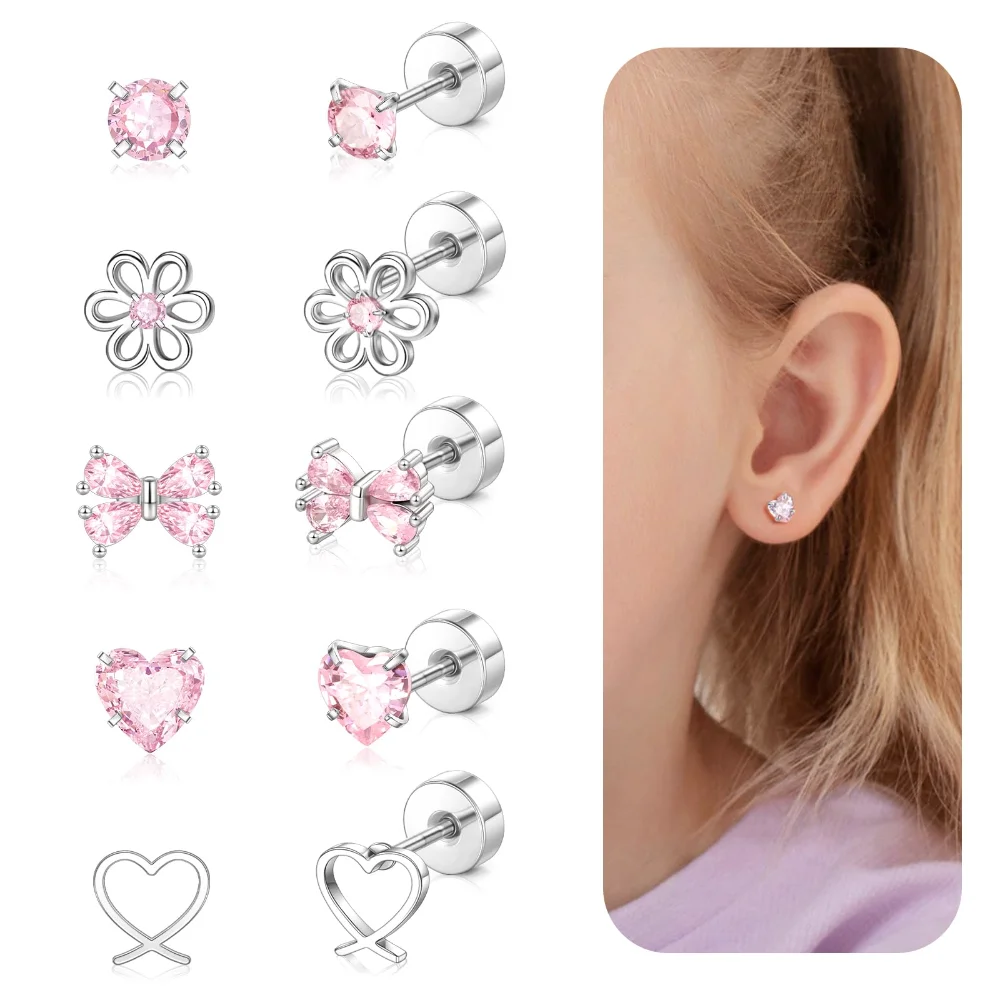
DAILI Surgical steel screw back earrings for children with a flower
5 pairs · 316L surgical steel, 20G · Screw back
$9.49
When the piercing happens
The American Academy of Pediatrics says to postpone piercing until the child is old enough to look after the site themselves. That guidance puts the child’s readiness before a date on the calendar. It does not give us a universal birthday to apply to every child.
The same body says a doctor, nurse or experienced technician should do the piercing, using disinfectants. Those are the people named in its guidance. We do not add another standard or turn a product description into medical advice.
This distinction matters because a first pair may be discussed long before the piercing takes place. Our range can help you compare backs, fronts, metals and pack sizes, but it cannot decide whether your child is ready to care for the site. That decision belongs with you and the named health guidance.
The American Academy of Pediatrics names a round gold-post earring for the first earring because gold reduces the risk of an allergic reaction. Its advice is about the first earring after the piercing, not a general approval of every gold-plated piece or every design in a jewellery range.
Our children's shelf includes 20G posts, measuring 0.8 millimetres, in titanium and 316L surgical steel, with some fronts described in our product data as having 14K gold plating. Those details help you understand a listed pair. They do not change the paediatric guidance.
A calendar can tell you when a birthday arrives. It cannot tell you whether your child can look after the site. The American Academy of Pediatrics makes the child’s ability to do that the starting point.
The first four to six weeks
The American Academy of Pediatrics says the first earring should not be removed for four to six weeks. It also says the earring should be gently rotated each day. Those instructions belong to the early period after piercing, when the site needs the care described by that body.
The same guidance says that if the area becomes red or tender, an infection may be developing and you should seek medical attention promptly. We will not interpret redness, tenderness or any other change from a product page. A doctor is the person to ask when the question is medical.
This is the one part of the process a shop has no business advising on. A jewellery guide can explain how a screw back turns, what a flat back looks like, or how many pairs a box contains. It cannot assess a child’s healing or replace a clinician’s advice.
Keep the roles separate. The American Academy of Pediatrics gives the four-to-six-week instruction and the gentle-rotation instruction. A doctor gives advice for a particular child when the area looks or feels different.
The back you choose still matters during this period, but it does not alter the care instructions. A screw back has a threaded connection. A flat back has a disc against the skin. Neither description tells you whether a piercing is healing as it should.
Once the first period has passed, you can consider the pair in the context of everyday wear. Until then, follow the named health guidance and ask a doctor about concerns. Product information should stay in its lane.
Why the back becomes the decision
After the early period, the back often becomes the practical decision because it is the part that meets the day. A butterfly clutch has two wings and a rim. It can be pulled off when a jumper comes over the head, when hair is brushed, or when a child is in a swimming pool.
That does not mean every clutch will come off in each situation. It means the mechanism allows the back to be pulled off. If the child does not notice at once, the missing pair may only become clear at bedtime.
A screw back has a thread cut into the post. The front turns on that thread and does not come off until it is turned back. The difference is simple to see when you hold the pieces together. One back is sprung. The other uses turning.
Flat backs take a third form. The back is a plain disc that lies against the skin. Our children’s shelf includes flat back pairs as well as screw back pairs, so you can compare the shape rather than treating every pair as the same construction.
Your child’s routine may guide the choice. Hair brushing, changing clothes, swimming and bedtime all involve hands, fabric or movement around the ear. A threaded front changes how the pair is opened, while a clutch changes how it is removed.
No mechanism can prevent a child from touching or removing jewellery. The point is narrower. Look at what has to happen for the back to come off, then choose the construction you can manage at home.
That is why the front is not the whole decision. A favourite shape may start the conversation, but the back decides how the pair is handled.
Size, in millimetres
Our children’s pairs use 20G posts, which measure 0.8 millimetres. That number describes the post, not the visible decoration on the front. The fronts in this shelf measure either five or six millimetres across the face.
A five-millimetre front is smaller across than a six-millimetre front. The difference is one millimetre, but it changes the amount of jewellery sitting visibly on the ear. Size gives you a way to compare designs without relying on a photograph.
The smaller front leaves less to catch on a collar, hairbrush or jumper coming off over the head. That is a practical consequence of having less material across the face. It does not tell you how a particular child will react to the pair, and it does not replace attention to the back.
A six-millimetre front gives a little more visible area for the listed designs. Our range includes cubic zirconia, flowers, hearts, bows, stars and glittered balls. The design and the measurement are separate details, so look at both when comparing pairs.
The post measurement is separate again. A 20G post is 0.8 millimetres, while the five or six millimetre figure describes the front across its face. Keeping those measurements apart makes product descriptions easier to read.
Some parents begin with the front their child points to. Then they compare the post, the back and the front measurement. That order keeps the visible design in the conversation without letting it answer every practical question.
There is no need to turn a millimetre into a promise. Five millimetres means five millimetres across the face. Six means six. The useful choice comes from matching those details to the way your child handles clothing, hair and jewellery.
Metal and the words on the packet
Words on packaging can sound more definite than the information behind them. We keep the description tied to the metal named for the pair, rather than using a broad label as a guarantee about a child’s skin.
The American Academy of Dermatology says nickel is one of the commonest causes of allergic contact dermatitis and names earrings and earring backs among the biggest culprits. It lists surgical-grade stainless steel, 18, 22 or 24 karat yellow gold, pure sterling silver and platinum as metals less likely to trigger a reaction.
The U.S. Consumer Product Safety Commission says an accessible component of a product designed or intended primarily for children twelve years of age or younger must not contain more than 100 parts per million of total lead. That is a rule about lead content, not a statement that every pair suits every child.
We print the metal named in our product data on the card. For this shelf, that can be titanium or 316L surgical steel, with some pieces also described as having 14K gold plating. Read the card for the pair in front of you.
| What the packet says | Who actually says something about it | What we print |
|---|---|---|
| Hypoallergenic | No named public body in the guidance supplied here | Titanium or 316L surgical steel, as listed for the pair |
| Nickel-free | The American Academy of Dermatology discusses nickel and metals less likely to trigger a reaction | Titanium or 316L surgical steel, as listed for the pair |
| Lead-free | The U.S. Consumer Product Safety Commission sets the total lead limit for accessible components intended primarily for children twelve and under | Titanium or 316L surgical steel, as listed for the pair |
If your child has a reaction or you are concerned about one, ask a doctor. A packet phrase cannot diagnose an allergy, and a catalogue cannot tell you what to use next.
What can go wrong later
The NHS lists the signs of an infected piercing: swelling, heat, dark redness or pus, and feeling unwell. It says these signs mean asking for an urgent appointment. We do not assess those signs from a photograph or product description.
For cleaning an infected piercing, the NHS says to use warm salty water twice a day. It also says to turn the jewellery gently while it is wet, not when it is dry, and not to pick the crust. Those instructions come from the NHS and stay within that guidance.
The NHS says the jewellery stays in unless a doctor says to take it out. That point is easy to lose when a parent sees a change and wants to remove the pair straight away. The named health guidance gives a different instruction, so follow it and seek the appointment it recommends.
A doctor is the right person for a medical question. Ask one about swelling, heat, dark redness, pus, feeling unwell or any concern about what is happening at the site. We can explain the construction of a screw back or flat back, but we cannot tell you what a symptom means.
Our product details may help you identify the pair you are handling. They tell you whether the design uses a screw back or flat back, the listed metal, the post gauge and the front measurement. Those details do not explain a health change.
If no medical concern is present, everyday handling still deserves care. Turn a screw back rather than pulling it, and remember that a flat back has a disc lying against the skin. If the question is about the piercing, move from catalogue guidance to a doctor.
The box of twelve
A box of twelve is useful when you want a few matching options and a pair kept aside. Our children’s boxes hold five, eight or twelve pairs, so the largest box gives you more than one design to organise at home.
Parents have written about pairs lost at school and in swimming pools. Others have chosen twelve pairs because one tends to go missing each term. These comments describe buying habits, not a promise that a larger box will prevent loss or suit every family.
A spare pair in a drawer has a simple job. It gives you a replacement when one earring cannot be found, without changing the pair your child has been wearing or making you choose a new design in a hurry.
You can keep the spare with the product card, so the metal, post and front measurement remain easy to identify. That helps when you compare a replacement with the original pair. It also keeps the practical details close at hand.
The front may be a flower, heart, bow, star or glittered ball. The box may contain five, eight or twelve pairs. The back may be a screw back or a flat back. Each detail answers a different part of the decision.
Start with the child’s readiness and follow the American Academy of Pediatrics guidance for a new piercing. For later choices, look at the back, the millimetres and the metal named on the card. Then choose the box size that leaves you with a pair set aside, ready for an ordinary change at home.
More of this sort of thing is in the Notes, we at DAILI keeps the whole range one click away on the front page, and the sources behind every checkpoint and carry-on statement are listed on how we update the catalogue.